
What Is a Systainer?

A systainer is a stackable, modular storage case system engineered and manufactured by TANOS in Germany. For more than thirty years it has been the organizing system of choice for professionals and makers, refined across three generations of product.
Four things define it: a broad portfolio of case types and sizes, a range of color schemes to organize by, a one-handed catch that stacks and locks cases into a single unit, and — with Systainer³ — a rail system built into the case for mounting in vehicles and workshops.
Own a Festool tool? You already own systainers. The case it came in is a systainer wearing Festool’s livery — the light gray body with a green catch. It is not a separate product line, and it needs no adapter: it stacks and locks with every other systainer, whether that’s an anthracite case, a Mirka or Mafell one, or a Classic from 1993. One system.
On this page
Who Makes the Systainer
TANOS GmbH, based in Illertissen, Germany, engineers and manufactures every systainer. TANOS is part of the TTS Group, which also owns Festool and SawStop. One of this site’s own submissions is a visit to the assembly line — cases photographed minutes after molding, before they go out wearing whichever brand ordered them.
That corporate relationship is the source of a common mix-up. Festool sells its power tools in systainers and did more than any other brand to popularize them, so the case and the tool brand are often treated as the same thing. They aren’t: Festool does not manufacture systainers. TANOS does. Festool is one of hundreds of brands that buy systainers from TANOS to package their own products.
Where the Systainer Came From
TANOS launched the first systainer — the design the community now calls the Classic — in 1993. More than 45 million have been sold since.
The locking mechanism has changed since then. The Classic used four separate catches, one at each corner. In 2010 the T-Loc generation replaced them with a single patented catch — one twist locks a case to the stack, opens the lid, or releases it again, all one-handed — working against a redesigned cleated foot.
Systainer³ followed in 2019, developed by TANOS together with bott and Festool. It refined the catch again and stiffened the case, but the significant change was mounting: Systainer³ has a rail profile built into the case itself, so it slides directly into compatible vehicle and workshop racking instead of needing separate rail hardware bolted on. That is what turned the systainer from a case that travels well into one that is part of the vehicle.
What survived every change is the stack itself. Each generation reworked how a case locks, and none of them broke compatibility with what came before, which is why the system spans three decades instead of replacing itself every few years.
The Three Generations
| Generation | What defines it |
|---|---|
| Classic 1993 | The original. Four catches, one at each corner, engaged individually to lock a case to the one below it. |
| T-Loc 2010 | Replaced the four catches with a single patented T-Loc catch — one twist to lock, open, or release, one-handed — working against a redesigned cleated foot. |
| Systainer³ 2019 | The current generation, developed with bott and Festool. Refined catch, stiffer case, updated sizing, and a rail profile built into the case for mounting in vans and workshops. |
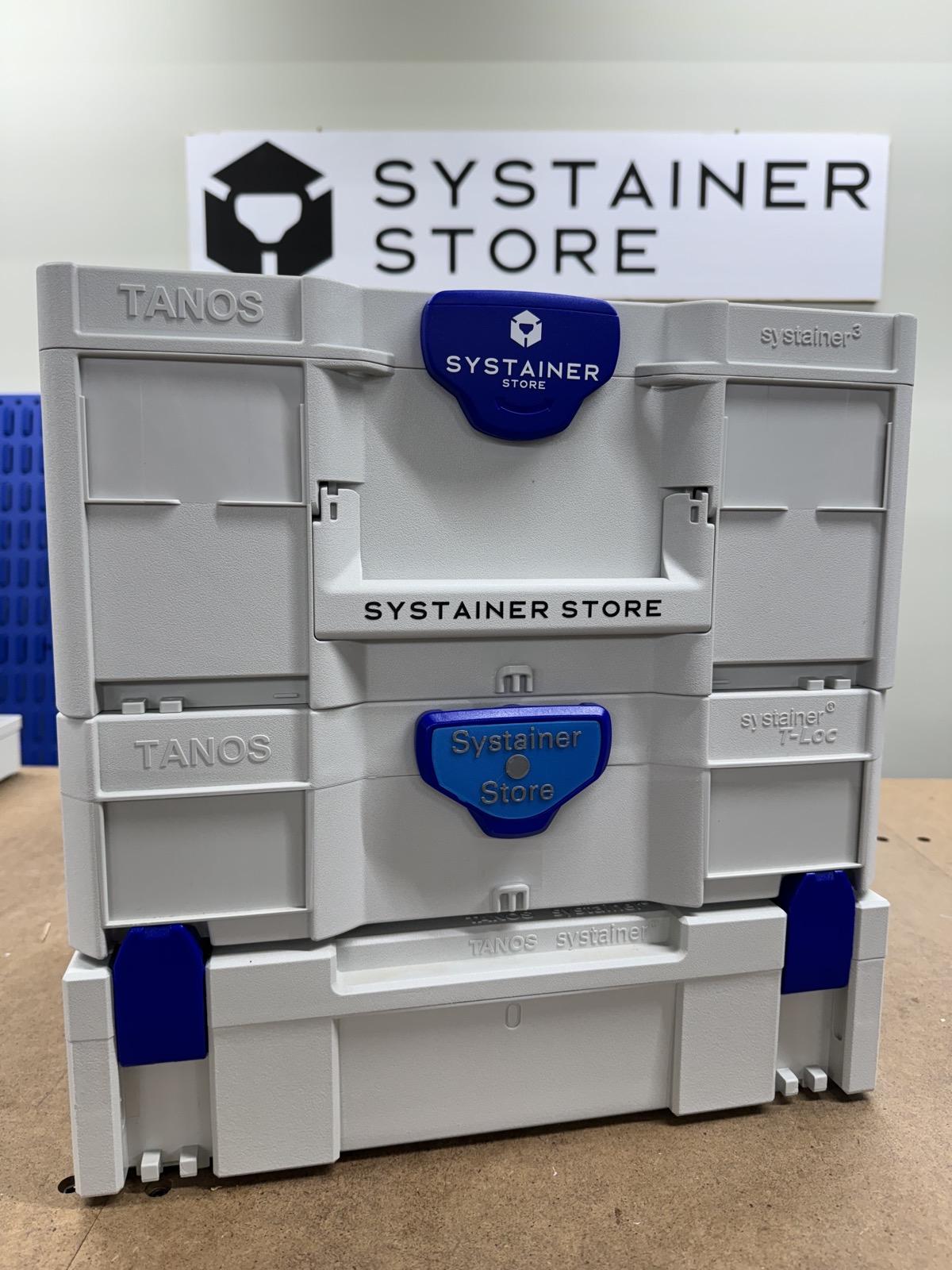
All three generations remain part of one compatible stack. A Classic can sit under a T-Loc or a Systainer³ without an adapter — see all three stacked together.
What Sizes Systainers Come In
Systainer³ footprints are named like t-shirt sizes — XXS, S, M, L, and XXL — describing the front-to-back and left-to-right dimensions. M is the most common. Each footprint is then offered in a range of heights.
That range is the point. Organizing a real kit takes more than one size of container — a set of drill bits and a cordless saw do not want the same box — so a system that only comes one way ends up half-used. Several footprints, each in several heights, each available as more than one type of case, is what lets one system cover a whole kit rather than part of it.
The model names read straight off that scheme. A Systainer³ M 112 is the Systainer³ generation, in the M footprint, 112 mm tall measured outside. An M 437 is the same footprint and a good deal deeper. Where a case is a specific type rather than a plain box, that gets named too — Systainer³ Organizer M, Systainer³ Sortainer, Systainer³ Combi.
The lineup goes well beyond a box with a lid. The same stacking footprint is used for:
- Boxes — the standard case, in every footprint and height
- Drawers — the Sortainer line in two- and three-drawer configurations, plus the SYS-Combi, which pairs a drawer with a lidded compartment above it
- Organizers — insert boxes for fasteners and small parts
- Tool boxes — open-top carriers built on the same base
- Tool bags — soft-sided, stacking on the same geometry
Two color schemes are standard: an all-anthracite case in dark gray, or a light gray body, lid, and handle with a signal blue catch — the case pictured at the top of this page. Festool’s own systainers use that same light gray body with a Festool green catch. Beyond the two standards, many models offer color options for the body, catch, and handle. The current range is at Systainer USA.
Organizing Within the System
The breadth of the range is what makes systainer an organizing system rather than a set of containers. Because every format shares one footprint, the container can be matched to the contents without breaking the stack: an organizer of insert boxes for fasteners, a drawer for the things reached for hourly, a deep box for bulky kit, a bag for what gets carried by hand.
Two more layers sit on top of that, and both are used heavily by the people who submit fitouts here:
- Color — because body, catch, and handle colors vary across the range, a stack can be coded by trade, by job, by vehicle, or by who owns it, and read at a glance across a workshop.
- Labeling — Systainer³ has two card slots molded into the front face, each sized for a standard CR80 card, the same dimensions as a credit card. A printed card drops straight in and can be pulled and swapped when the contents change, with no adhesive and no residue. Beyond the slots, the flat lid and front faces take labels well, and this community uses vinyl, die-cut stickers, direct-to-film transfers, and 3D-printed label holders.
Inside the case, custom inserts — cut foam, 3D prints, or off-the-shelf insert boxes — hold each tool in a known place. None of this is required to use a systainer, and how far to take it is a matter of taste; the point is that the system is built to be organized rather than merely filled.
How Festool and the Other Brands Fit In
TANOS uses two terms for the businesses around the systainer, and they mean different things.
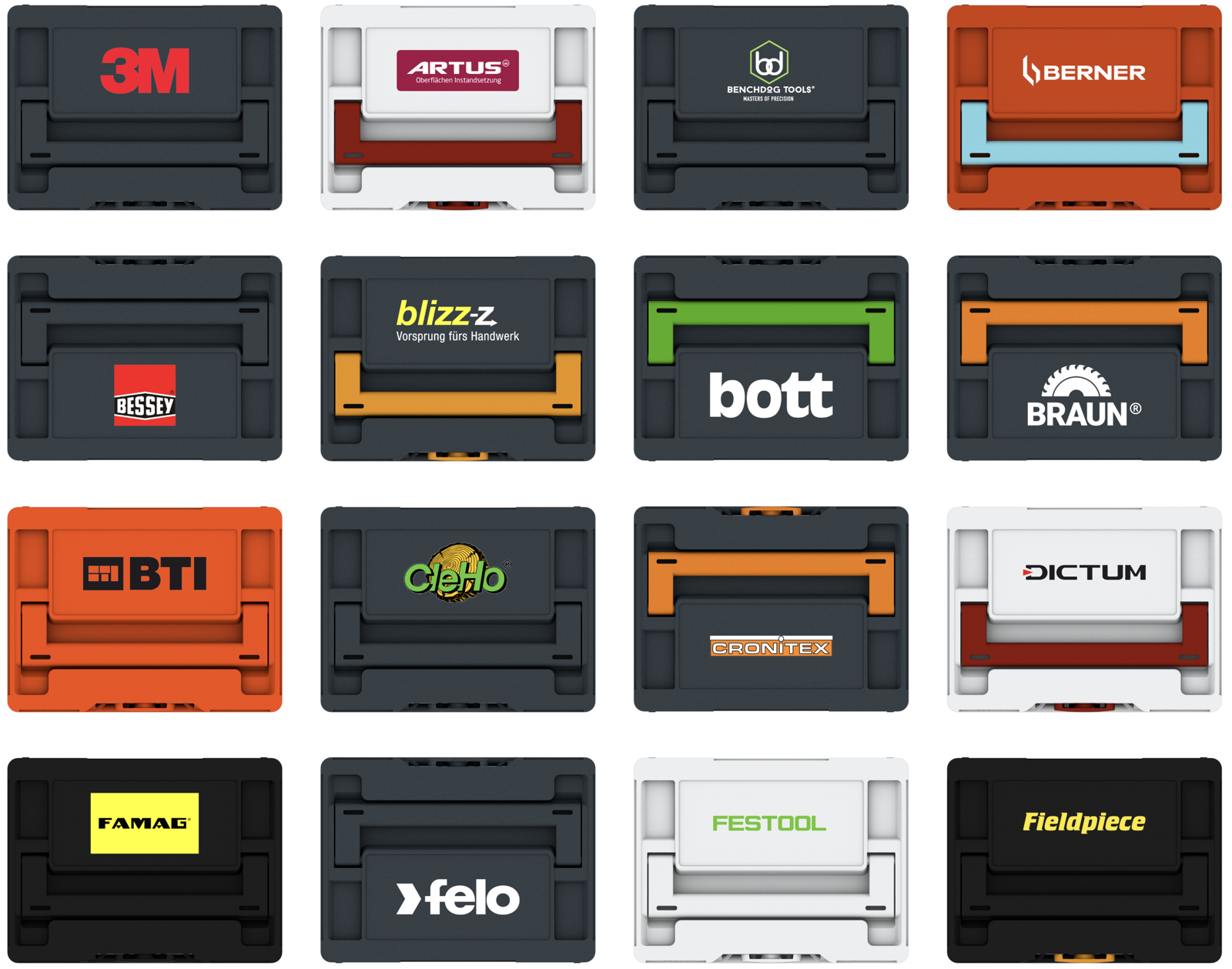
A System Partner is a brand that packages its own products inside systainers. Festool is the best known, but there are hundreds — Mirka, Veritas, and Mafell each ship products in systainers bought from TANOS, with their own branded colors, molded logos, and custom inserts. A systainer made for Festool and one made for another System Partner are fully compatible with each other: same geometry, same catches.
A Systainer Partner is different. It’s a business making things compatible with systainers rather than shipping products in them — mounting hardware, racks, inserts, organizers, or professional fitout work built for the systainer footprint. Real examples are tagged Systainer Partners across this site.
What Stacks With What
The short answer is that nearly all of it stacks together. The detail:
- Across generations — thirty years on, compatibility has largely held. A Classic sits under a T-Loc or a Systainer³, and T-Loc and Systainer³ are freely interchangeable. Here are all three stacked together.
- Across brands — a System Partner’s Systainer is the same case with different branding, so a Festool case and a Mirka case stack together normally. Every Systainer, whichever badge it carries, comes off the same line.
- Across formats — boxes, drawers, organizers, and tool bags in the same footprint all connect to each other.
- Across systems — Systainer³ in particular drops into a wider ecosystem: bott van and workshop racking, FORG3D mounts and accessories, community 3D prints, and plenty more built by Systainer Partners.
The practical consequence is that a systainer bought today still works with one bought decades ago, and a stack can mix brands, generations, and formats without adapters.
See Real Systainers in Use
Everything above describes the system. The rest of this site is what people actually do with it — every entry is submitted by the person who built it.
- Fitouts — individual Systainer builds: inserts, layout, labeling
- Workshops — full shop setups built around Systainer storage
- Vehicles — vans, trucks, and trailers with Systainer racking
- Worksites — job site and field setups
- Browse by tag — by size, brand, trade, or use case
Wondering whether it’s the right system for you? Read Why systainer.
Frequently Asked Questions
What is a systainer?
A systainer is a stackable, modular storage case system engineered and manufactured by TANOS in Germany. Cases lock to one another so a stack can be carried, mounted, or racked as a single unit - on current T-Loc and Systainer³ cases that is a single one-handed catch working against a cleated foot. The system has stayed largely compatible across three generations since 1993.
Does Festool make systainers?
No. TANOS manufactures every systainer. Festool sells its power tools in systainers and did more than any other brand to popularize them, and both companies are part of the TTS Group - but Festool is one of hundreds of brands that buy systainers from TANOS to package their own products.
Is TANOS part of a larger company?
Yes. TANOS is part of the TTS Group, which also owns Festool and SawStop.
What's the difference between Systainer³, T-Loc, and Classic?
They are the three generations of systainer. Classic is the original 1993 design, using four catches to stack. T-Loc introduced a patented one-handed catch mechanism. Systainer³ is the current generation, building on T-Loc with updated materials and sizing, plus a rail system co-designed with bott that expands how systainers mount in work vans and workshops. All three generations stack together.
Are all systainer generations compatible with each other?
Largely, yes. A Classic stacks underneath a T-Loc or a Systainer³, and T-Loc and Systainer³ are freely interchangeable. The catch mechanism changed when T-Loc arrived in 2010, but the stacking footprint carried across all three generations, so a thirty-year-old case still earns a place in the stack.
What sizes do systainers come in?
Systainer³ footprints are named like t-shirt sizes - XXS, S, M, L, and XXL - describing the front-to-back and left-to-right dimensions, with M the most common. Each footprint comes in a range of heights. Beyond the standard box, the same footprint is used for drawers, tool boxes, organizers, and tool bags. See Systainer USA for the current lineup.
What is the difference between a System Partner and a Systainer Partner?
A System Partner is a brand that packages its own products inside systainers - Festool, Mirka, Veritas, Mafell, and hundreds of others. A Systainer Partner makes things compatible with systainers instead: mounting hardware, racks, inserts, organizers, or fitout work built for the systainer footprint.