
Why Systainer?
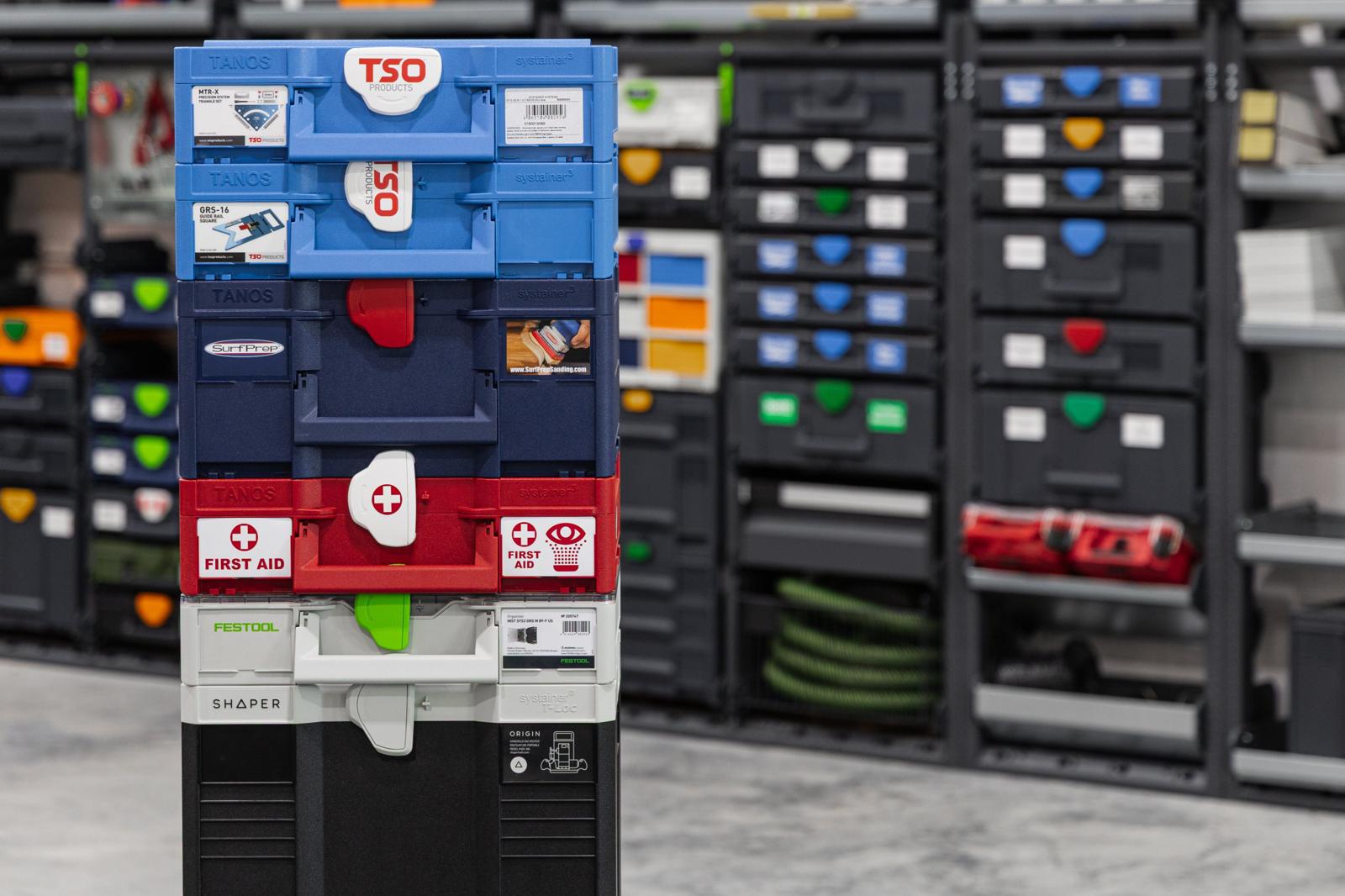
Systainers show up everywhere in this community’s fitouts — vans, workshops, job sites, even a mobile pizza operation — for a few specific reasons that keep coming up when people explain why they chose them. This page is the case for the system. If you’re after the definition first, What Is a systainer? covers who makes them, the generations, and the sizes.
Built Light, On Purpose
Systainers are molded from ABS plastic, engineered to be as light as possible without giving up rigidity. That difference shows up before you’ve put a single tool inside — it’s the weight of the empty case itself. Several people who’ve made the switch from other systems point to exactly that moment as what convinced them.
William Kucharski, who runs Front of House sound at his church, switched his cable and gear storage from Milwaukee PACKOUT to Systainer³ and put it simply: PACKOUT “worked, but the cases took up a lot of space, and the closures made it frustrating to get in and out quickly.” Two Dog Pizza made the same move for a mobile catering setup that has to fit in a VW Tiguan.
Ryan Almeida, a general contractor on the Massachusetts Southcoast, puts the empty-case problem about as plainly as it can be put. He liked PACKOUT enough to build a trailer around it — “when the drawers came out, kind of a game changer for me” — and then ran into the arithmetic: “then I realized they’re just so heavy.” His PACKOUTs stayed, bolted into the trailer as fixed storage. What he carries into a kitchen now is a systainer stack, and the spec he set himself was a stack “that doesn’t weigh 250lbs empty.”
More Storage Per Inch of Space
Systainers come in a range of footprints designed to stack and interlock with each other, so a fitout can be built exactly to the space available — a van shelf, a workbench, a backseat — without wasted volume. Given that design, it’s hard to find a toolbox system that packs more usable storage into its footprint.
That’s not just a claim — it’s what happened when Two Dog Pizza rebuilt his mobile pizza setup around systainers: the new setup holds 95% of his previous gear in 40% of the space, both in the vehicle and back on the garage shelves.
Systainers aren’t one-size-fits-all, either. The lineup spans a wide range of footprints and heights that all stack together, and many models offer color options for the body, catch, and handle — so a fitout can be sized and styled to match the exact job, not just made to fit it. Browse the full range at Systainer USA.
Nothing You Buy Gets Stranded
A systainer bought today still stacks with one bought in 1993. Three generations on, compatibility has largely held — there are exceptions here and there, but the general rule has survived three decades, which means a fitout can be added to over years instead of replaced when the range moves on, and a used Classic picked up cheap still earns a place in the stack. (How the three generations differ.)
That is an unusually long compatibility promise for a storage system, and it changes the arithmetic on buying in: the cases are an accumulating asset rather than a bet on the current lineup.
Trusted Enough That Brands Build Around It
Hundreds of tool brands package their own products in systainers — Festool, Mirka, Veritas, Mafell, TSO Products, UNEEDA, and MicroJig among them. That is a meaningful vote of confidence: a manufacturer choosing someone else’s case system for its flagship products is betting its own unboxing experience, shelf presence, and warranty returns on that case holding up.
The practical benefit for everyone else is that a systainer bought with a Mirka sander stacks with the one that came with a Festool saw. (The difference between a System Partner and a Systainer Partner.)
Fits Out Easily With Help From Systainer Partners
There is a whole ecosystem of makers building mounting hardware, racks, organizers, and professional fitout work for the systainer footprint — tagged Systainer Partners on this site. That matters more than it sounds: it means fitting out a stack rarely starts from scratch. Whatever the job, someone has usually already solved a version of it and sells the part, whether it’s a first stack or a fiftieth.
Built for Every Trade and Every Bench
Fitouts on this site come from a lot more than woodworkers and tradespeople. Real submissions come from anesthesiologists and other medical and dental professionals, electricians, plumbers, HVAC techs, automotive work, carpentry and woodworking, photographers and other creatives, and even a mobile pizza caterer. If a job needs things organized, protected, and easy to grab, there’s probably already a systainer fitout for it.
Works Well Alongside Other Systems, Too
None of this is an argument that you have to give up the storage you already own. Plenty of fitouts in this community run systainers beside other case systems in the same van racking, and that works perfectly well. Systainer just tends to be what people reach for first once they’ve tried it, especially anywhere weight and footprint matter.
Where it does pull ahead is how far the system reaches beyond the stack itself. Festool ships its tools in systainers, so a Festool purchase arrives already part of the system. bott builds workshop furniture and Smartvan racking designed to take systainers directly, which means the same stack can live on a bench, lock into a van, and come out again on site without being repacked. That continuity from workshop to vehicle to job is hard to assemble out of unrelated boxes.
That is the whole argument, really. One system. For everything. For everyone.
Frequently Asked Questions
How does systainer compare to other toolbox systems on weight?
systainers are molded from ABS plastic and engineered to minimize weight while staying rigid. That difference is noticeable even with the case empty, before anything is loaded into it - it’s specifically what several contributors to this site point to when explaining why they moved over from heavier, bulkier case systems.
Can I use systainer alongside other storage systems?
Yes, and plenty of people do. The systainer range is wide enough to cover most of a kit on its own - boxes, drawers, organizers, tool boxes and bags across five footprints and a range of heights, in two standard color schemes plus per-model color options, and the portfolio is still expanding. But the right tool for the job wins, and you’ll find systainers sitting alongside other tool boxes in a lot of the real fitouts on this site.
Is it worth switching if I already own another system?
It doesn’t have to be a switch. The question worth asking is how often your tools move. If you’re carrying kit between a workshop and a worksite, the weight and the organization of every single trip compound - and that’s where the contributors here say the difference showed up. Most moved gradually rather than all at once, starting with whatever they carried most often, and several kept their older cases in fixed roles like trailer or shop storage.
Where do I start with systainer?
Start with what you need to store and how much space you have to work with - the modular stacking system means you’re not locked into one size or configuration up front. Browse fitouts from a trade or use case similar to your own for real-world inspiration, then see the current lineup and starter options at Systainer USA.